

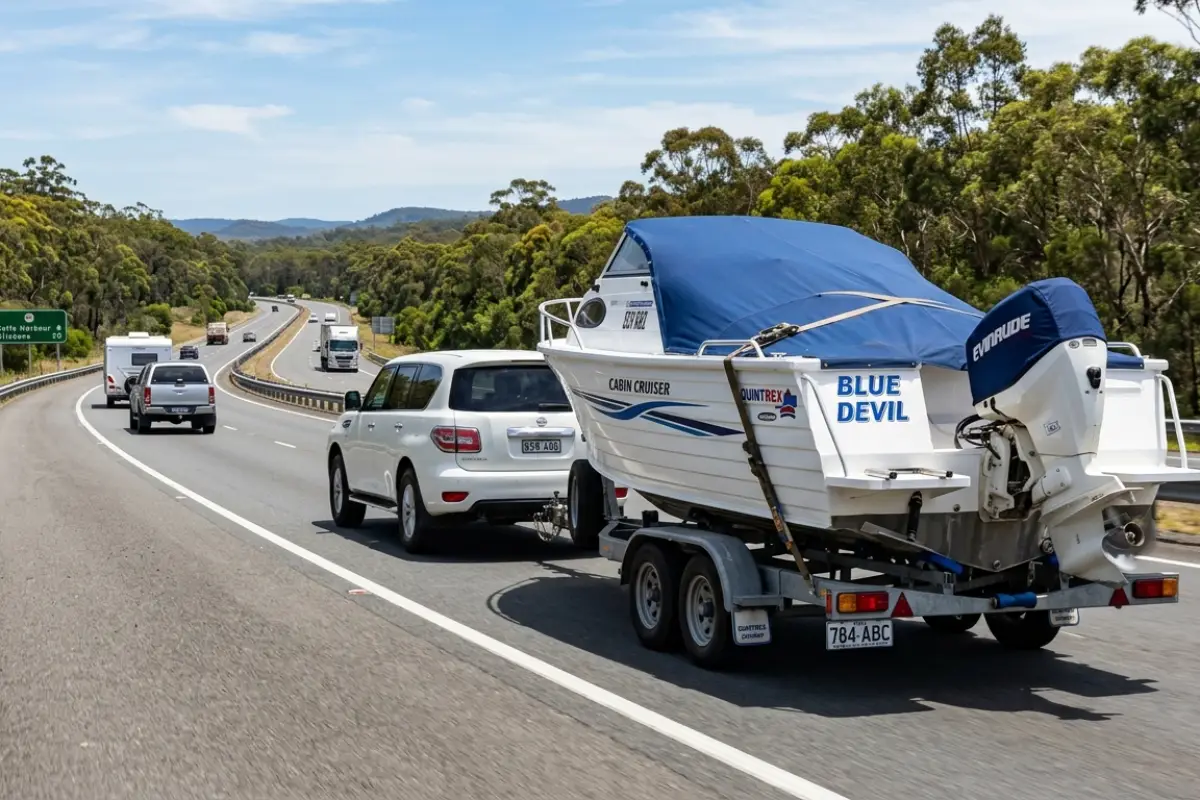

Buying a boat in another state or relocating with one raises an immediate problem: how do you get a vessel across the country safely?
Boats are awkward loads. They are wide, heavy, and easily damaged, and the rules around oversize trailers differ once you cross a border. Getting it wrong means damage, fines, or both.
This guide walks through the transport methods, the preparation that protects your hull and drivetrain, the permit basics, and how to decide between towing it yourself and hiring a specialist.
Table of Contents
- The two main transport methods
- Preparing your boat for transport
- Oversized loads and interstate permits
- Towing it yourself vs hiring a transporter
- What it costs and what drives the price
- Choosing a boat transporter
- What to expect on the day
- Mistakes that cause damage
- Common questions
The two main transport methods
Almost every interstate boat move uses one of two approaches, and the right choice depends on your boat’s size and trailer.
Towed on its own trailer
If your boat sits on a registered, roadworthy trailer, a transporter can hitch it and tow it to the destination. This is the most common and economical method for trailerable boats.
Loaded onto a truck or float
Larger vessels, boats without a roadworthy trailer, or very wide hulls travel on a flatbed truck or float. This costs more but suits boats that cannot legally or safely be towed.
A rough rule of thumb helps you predict which method applies. Trailerable boats under about 2.5 metres wide and 7 metres long usually tow on their own trailer, while anything wider or a cruiser without a roadworthy trailer almost always needs a float.
Demand for relocation grows alongside ownership as buyers increasingly purchase boats interstate, and many of those hulls are wide enough to bring the move under oversize load rules before it even starts.
Preparing your boat for transport
Good preparation prevents most transport damage, and it is the part that owners most often rush.
Secure everything on board
Remove or tie down loose gear, electronics, cushions, and safety equipment. Anything left loose can fly around and crack interior fittings during the trip.
Protect the hull and drivetrain
Drain water systems, disconnect the battery, and trim the outboard or sterndrive to the recommended travel position. Cover or pad vulnerable points to stop wind and road grit from causing damage.
Check the trailer
If the boat travels on its own trailer, inspect tyres, lights, brakes, and the coupling. A trailer fault is a common cause of breakdowns and delays mid-route.
Pay particular attention to the trailer tyres. Boat trailer tyres often perish from sun and salt long before they wear out, so a tyre that looks fine can fail under load on a long highway run.
Document the condition
Photograph the hull, gelcoat, windscreen, and any existing chips before pickup. A dated set of photos settles any dispute about damage that appears in transit and is your strongest evidence for an insurance claim.
Oversized loads and interstate permits
Boats often exceed standard width limits, which brings them under oversize load rules.
The National Heavy Vehicle Regulator sets the standard width limit for a heavy vehicle at 2.5 metres, so a load wider than that is generally classed as oversize and may require a permit, pilot vehicles, or travel-time restrictions. These thresholds vary by route and state.
Crossing borders means meeting the requirements of each jurisdiction you pass through. A professional transporter handles these permits as part of the job, which is one of the strongest arguments for not doing a wide-hull move yourself.
Width also triggers practical conditions beyond the permit itself. Wider loads may need warning flags and signs during the day, lit warning lamps, and, in some cases, a pilot vehicle running ahead of or behind the load.
Travel-time limits apply too. Oversized loads are often restricted from peak-hour travel through cities and from moving in poor visibility, which is part of why a wide boat can take longer to move than its distance suggests.
Towing it yourself vs hiring a transporter
Towing your own boat is realistic for small, trailerable vessels on short routes. For larger boats or long hauls, the calculation changes.
Self-towing means fuel for a heavily loaded vehicle, accommodation, days away from work, and full responsibility for permits, tie-downs, and any damage. Towing a wide load across multiple states is also genuinely demanding driving.
For owners who want the vessel handled end to end, a specialist such as Interstate Boat Transport manages the loading, securing, permits, and the long-distance leg, which removes both the driving and the paperwork from your plate. The honest comparison is convenience and risk reduction against the fuel and time you would otherwise spend.
What it costs and what drives the price
Interstate boat transport is usually priced by distance, with the final figure shaped by a handful of factors.
| Factor | Lower cost | Higher cost |
| Size and width | Small trailerable boat | Wide hull, oversize load |
| Method | Towed on own trailer | Loaded on a truck or float |
| Route | Capital to capital | Remote or regional |
| Permits | Within standard limits | Oversized, needs pilots |
Request several written quotes and confirm the insurance cover for transit. The lowest price is only a saving if the vessel is properly protected during the move.
Ask each quote to spell out what is included. A figure that excludes the oversize permit, pilot vehicle, or fuel levy can end up dearer than a higher quote that bundles everything in.
Choosing a boat transporter
The right operator protects both your hull and your hip pocket. A few checks separate a reliable carrier from a risky one.
Confirm they hold goods-in-transit or marine transit insurance and ask for the cover limit and excess in writing. A vessel can be worth far more than a standard policy pays out, so the number matters.
Ask whether they have moved boats of your size and type before. Loading a heavy cruiser, securing it without stressing the hull, and managing oversize permits is specialist work, not general freight.
Look for an operator who completes a written condition report at pickup and delivery. Check reviews for mentions of careful handling and clear communication rather than focusing only on the lowest price.
What to expect on the day
Knowing the sequence helps you prepare and avoid hold-ups that add cost.
The driver inspects and photographs the boat, then loads and secures it with straps over the hull and the trailer, never over fragile fittings. You sign the condition report before they leave.
For an oversize load, departure may be timed around permitted travel windows, so the truck might leave early or wait out a restricted period. Delivery follows the same inspection and sign-off at the other end.
Mistakes that cause damage
Most transport damage traces back to a handful of preventable errors.
Leaving water in the bilge, live wells, or plumbing can freeze or slosh and crack fittings on a long haul. Drain everything before pickup. Leaving the outboard down rather than trimmed to the travel position risks the leg and the transom.
Loose gear left on board is another common cause. Anything not removed or tied down becomes a projectile inside the cabin over hundreds of kilometres of road vibration.
Conclusion
Transporting a boat interstate comes down to choosing the right method for your hull, preparing the vessel and trailer properly, and meeting the oversize permit rules along the route. Get those three right and your boat arrives safely, whether you tow it yourself or hand the job to a specialist.
Curious about the people who haul loads like these across the country? See our related guide on becoming a truck driver in Australia for a look at the long-haul side of the job.
Common questions
Is my boat insured during transport?
Established transporters carry transit insurance, but limits differ between companies. Ask for the cover details in writing and check whether your own boat policy extends to road transit.
Do I need to remove the boat from the water before transport?
Yes. The boat must be on a trailer or ready for loading. Arrange haul-out and any cleaning ahead of the pickup date.
How long does an interstate boat move take?
Short routes between neighbouring capitals can be completed in a few days, while cross-country moves may take one to two weeks, depending on scheduling and permit requirements.
Can the boat stay on its trailer for the whole move?
If the trailer is registered and roadworthy and the combined width is within limits, the boat usually travels on its own trailer. A trailer that is unregistered or not roadworthy means the boat shifts to a float instead.
Should I leave fuel in the tank?
Keep the fuel low rather than full. A near-empty tank reduces weight and the risk of fuel sloshing or venting during the trip, and some transporters require minimal fuel for safety.
What if my boat is wider than 2.5 metres?
A hull wider than the standard limit is classed as oversize and needs a permit, and possibly flags, lights, or a pilot vehicle. This is best left to a transporter who arranges the permits and meets each state’s conditions along the route.